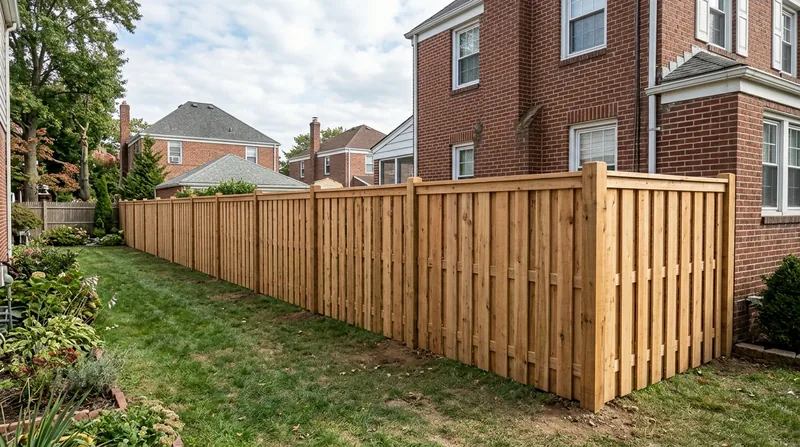




Privacy fence installation in New York City means building a solid 6-ft cedar or pressure-treated barrier that stands up to freeze-thaw winters, coastal salt air, and the tight geometry of outer-borough backyards. From Bay Ridge to Bayside, Riverdale to Tottenville, homeowners rely on board-on-board and stockade privacy fences to block sight lines, buffer noise, and define property lines on lots where every square foot counts. We set posts deep in concrete, use quality cedar or treated pine, and build fences that don't shift or gap when a nor'easter or heavy wet snow pushes through. This page explains how we build privacy fences in New York City, what to expect on cost, and how to hire the right contractor for the job.
Why Privacy Fencing Matters in New York City's Dense Neighborhoods
New York City's residential landscape is defined by proximity. Rowhouses in Brooklyn sit shoulder-to-shoulder, Queens colonials perch on 40x100 lots with neighbors on three sides, and even detached homes on Staten Island and Long Island face sight-line and noise challenges. A well-built privacy fence is the standard solution, and it has to work in conditions that test materials and installation every single year. Winter freeze-thaw cycles heave posts that aren't set deep enough, salt spray from Jamaica Bay and road salt corrode exposed fasteners and metal, and heavy wet snow loads that snap poorly braced panels. The soil itself varies: sandy fill near the South Shore, rocky glacial till in the North Bronx and Riverdale. A fence that lasts 15 to 20 years here is one built with posts in concrete, proper spacing, and materials chosen honestly for the budget.
- Board-on-board and stockade fences eliminate sight lines while handling wind and snow load better than single-sided construction.
- Posts set 3 to 4 feet deep in concrete stay put through winter heave, which is the primary failure mode in this climate.
- Cedar resists rot and looks better over time, but pressure-treated pine is a smart budget call and lasts just as long when properly installed.
- Galvanized or stainless fasteners prevent rust and panel failure from salt air and winter road salt.
These details separate a fence that holds for two decades from one that sags, gaps, or fails in year five.
Key info: Winter heave is the dominant failure mode in New York City. Posts that are set 2 feet deep or less will shift when the ground freezes and thaws. Our standard is 3 to 4 feet in concrete, depending on soil type and frost depth. This single detail is the difference between a fence that lasts 20 years and one that needs repairs in year 3.
For permit and height requirements specific to your neighborhood or HOA, check with your local community board or New York City Department of Buildings. Regulations vary by borough and zoning district.
How We Install Privacy Fences in New York City: Step-by-Step Process
A solid privacy fence starts with a plan and a utility locate. We begin every job by having you mark the fence line, and we call 811 for a free utility locate to avoid hitting buried electric, gas, water, or sewer lines. Posts are set on spacing appropriate to your material and wind exposure, typically 5 to 6 feet apart for wood privacy fencing. We dig post holes below the frost line, set posts in concrete, and let the concrete cure before hanging rails and pickets. For board-on-board fencing, we install pickets alternately on each side of the rails to create a solid wall with no gaps. The entire process takes 1 to 3 days depending on fence length and site access.
- We work from your survey or property markers to confirm the fence line, and we install where you identify the boundary.
- We call 811 for a free utility locate before we dig any post holes, a legal requirement in New York State.
- Posts are dug 3 to 4 feet deep, set in concrete, and braced until the concrete sets fully.
- Rails are attached to posts using galvanized or stainless hardware, with anti-sag bracing on longer runs.
- Pickets are cut to height and installed board-on-board, stockade, or side-by-side depending on your preference and budget.
- We cap the top of the fence and trim any rough edges for a finished appearance and to shed water.
The result is a fence that is plumb, square, and built to handle New York City weather for the long term.
Local example: A 60-ft board-on-board cedar fence in Bay Ridge with 3-ft posts in concrete, galvanized hardware, and a cap rail typically takes 2 days from post setting through final trim. The same fence in Bayside, where the soil is sandier and closer to the water table, may need posts set slightly deeper or with additional drainage consideration. We adjust the method to the site.
If you have an existing fence that needs repair, see our fence repair service for post replacement, panel fixes, and seasonal maintenance.
Wood Privacy Fence Methods and Materials
| Approach | Description | Best for |
|---|---|---|
| Board-on-Board Cedar | Pickets installed alternately on each side of the rails, creating a solid wall with no gaps. Cedar is naturally rot-resistant and weathers to a silver-grey over time. | Homeowners who want maximum privacy, a finished look, and are willing to invest in premium material. Common in Bay Ridge, Dyker Heights, and Riverdale. |
| Stockade Pressure-Treated Pine | Pickets run vertically and are butted tightly together, then mounted on horizontal rails. Pressure-treated pine is chemically protected against rot and costs less than cedar. Lasts 15 to 20 years with proper post setting. | Budget-conscious homeowners and rental properties. Widely seen on Long Island and Westchester lots where the fence is functional rather than a design statement. |
| 6-Ft Cedar Stockade | Full-height cedar pickets on a stockade frame, delivering both privacy and the warmth of natural wood. Cedar ages gracefully and can be stained or left to weather naturally. | Homeowners in established neighborhoods (Bayside, Whitestone, Country Club) who want a classic look and plan to maintain the fence with periodic staining. |
| Posts in Concrete vs. Tamped | Posts set 3 to 4 feet deep in concrete are the standard in New York City due to freeze-thaw heave. Tamped posts (soil-only) are rarely recommended here because winter expansion shifts them. | All permanent residential fencing in the New York City area. Concrete setting adds cost but is the only method that reliably prevents post heave and fence sagging. |
Wood and Privacy Fence Installation Cost in New York City: What to Expect
Privacy fence installation in New York City typically starts at $27 per linear foot for pressure-treated stockade fencing with posts in concrete, and runs higher for cedar, board-on-board construction, or difficult site access. A 100-ft fence around a typical outer-borough backyard ranges from $2,700 to $5,500 depending on material choice, soil conditions, and whether the fence line is straight or requires racking (stepped installation on sloped ground). Multiple factors drive cost: the material (cedar versus treated pine), fence style (stockade versus board-on-board), post spacing, soil type and the depth of frost line, proximity to structures or utilities, and site access for equipment and materials. Rocky soil in the North Bronx or Riverdale costs more to dig than sandy fill near Jamaica Bay. A fence that wraps around a corner or steps up a slope takes longer and may cost more per foot. Getting 2 to 3 estimates from local contractors gives you a realistic picture of what the job will cost in your specific location and with your specific site conditions.
For a detailed breakdown of pricing by material, style, and scope, visit our pricing overview page. We provide a free, no-obligation estimate within 24 hours; call (917) 994-6008 or request an estimate online.
What to Look for When Hiring a Fence Contractor Near Me in New York City
Hiring the right fence contractor is as important as choosing the right material. Look for a contractor who is fully insured with general liability and workers' compensation coverage, and who can provide a certificate of insurance on request. Ask about fence licensing in your jurisdiction; fence licensing in New York is set county by county, so requirements vary across the city and surrounding areas. Check references from recent jobs in your neighborhood, and get 2 to 3 written estimates so you can compare scope, material, and timeline. Understand whether your project requires a permit; some jurisdictions require permits for fences over 4 feet, while others have no fence permit requirement. If your property is in an HOA community, confirm that your fence style, height, and color meet architectural guidelines before you start. If you are installing a fence near mature trees, ask the contractor how they will protect root systems and avoid damage to protected or heritage trees, as some communities have tree preservation rules.
- Confirm the contractor carries general liability and workers' compensation insurance and can provide proof on request.
- Ask about fence licensing requirements in your specific borough or county, and understand that these rules vary across the New York City area.
- Request references from jobs completed in your neighborhood within the past 2 to 3 years.
- Get written estimates that spell out material, post depth, spacing, style, and the scope of any site prep or removal.
- Verify permit requirements with your local building department or community board before signing a contract.
- Check HOA or deed restrictions if your property is in a managed community, and confirm fence height, material, and color are approved.
A contractor who answers your questions directly, explains trade-offs honestly (cedar versus treated pine, stockade versus board-on-board), and walks you through the process is the one to hire.
Ready to get started? Contact us for a free estimate or call (917) 994-6008. We serve New York City and surrounding areas including Yonkers, Mount Vernon, New Rochelle, White Plains, Hempstead, Valley Stream, and Long Island.
Wood & Privacy Fence Installation in New York City: Pricing Guide
| Service | Price | Details |
|---|---|---|
| Pressure-Treated Stockade Privacy Fence | Starting at $27/ft | Posts in concrete, treated pine pickets, galvanized hardware, and cap rail included; cost varies by soil type and post spacing |
| Cedar Board-on-Board Privacy Fence | Starting at $42/ft | Premium cedar pickets, alternating installation, posts in concrete, stainless hardware, and finished trim; weather and grain quality affect final cost |
| 6-Ft Cedar Stockade Privacy Fence | Starting at $38/ft | Full-height cedar pickets, posts in concrete, galvanized fasteners, and cap rail; price reflects cedar grade and local delivery |
| Difficult terrain, racked installation, or limited access | On estimate | Sloped or rocky ground, tight backyard access, or complex fence lines require site visit to price accurately and safely |
| Travel and site visit | Included | No separate mileage fee or call-out charge in New York City and surrounding service areas |
| Free estimate | No obligation | Response within 24 hours at (917) 994-6008; estimate includes material, labor, timeline, and any site-specific considerations |
Indicative pricing, the exact cost depends on square footage, finish, and site access. Free personalized estimate within 24h at (917) 994-6008.


