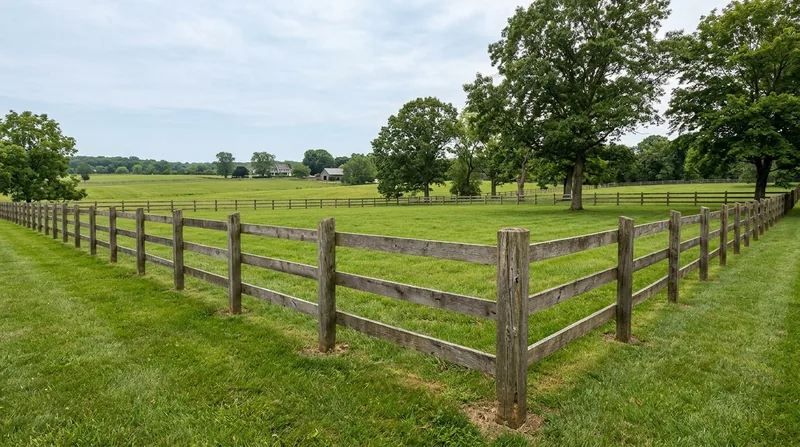




Farm fence installation in New York City serves a small but growing number of property owners across Staten Island, Nassau County, and Westchester who maintain horses, livestock, or large estates beyond the urban core. Unlike the standard privacy fences and chain link that dominate Brooklyn rowhouses and Queens subdivisions, ranch fencing demands a different approach: long straight runs over uneven terrain, frost-resistant post setting deep into the ground, and gates sized for trailers and equipment. The freeze-thaw cycle that heaves posts in winter, combined with heavy wet snow loads and nor'easters, makes proper installation and bracing critical to longevity. We work from the customer's existing survey or the line they identify, set posts in concrete on proper spacing, and brace corners for the seasonal forces that move soil and weather in the outer boroughs and nearby counties. Whether you're fencing pasture, securing a perimeter, or defining property lines on acreage, the work begins with understanding the site, the soil, and what actually holds in this climate.
Why Farm and Ranch Fencing Matters in New York City and Nearby Estates
Property owners with land in Tottenville, Great Kills, Riverdale, Throgs Neck, and the North Fork of Long Island face a unique challenge: standard residential fencing fails under the weight of coastal weather and the demands of livestock or equipment. Posts set shallow or tamped without concrete heave and shift in winter; panels buckle under snow load; and metal corrodes from salt air and road salt runoff. A well-built ranch fence with proper post depth, concrete footings, and corner bracing holds its line for 15 to 20 years, even in these conditions. The investment protects livestock, defines boundaries, and eliminates the costly repairs that come from frost heave and storm damage.
- Posts set 3 to 4 feet deep in concrete resist frost heave and seasonal soil movement.
- Corner bracing and anti-sag hardware distribute load across long runs and prevent panel failure in wind and snow.
- Split rail, no-climb horse fence, and pipe fencing provide visibility and strength without the maintenance burden of board fencing.
- Gates sized for trailers, ATVs, and equipment access must swing freely and close reliably in all weather.
- Proper spacing and material selection extend service life and reduce the frequency of post replacement and repair.
These details separate a fence that holds from one that requires constant maintenance and replacement.
Local example: A 200-foot no-climb horse fence on a Westchester estate set without proper corner bracing will show sagging and leaning within two winters. Posts set 42 inches deep in concrete with diagonal bracing at corners and every 50 feet hold straight and true through freeze-thaw cycles and 18-inch snow loads.
For guidance on local permit requirements and setback rules, check with your town or county building department. Fence height, material, and setback regulations vary across the region and may be governed by local code or HOA architectural standards.
How We Install Farm and Ranch Fencing Across New York City and Westchester
Farm and ranch fencing begins on the ground, not in the air. We walk the property line, identify obstacles and terrain changes, and plan post placement for strength and visibility. Frost-resistant installation means setting posts deep, using concrete to lock them, and bracing corners for the lateral forces that winter and storm weather deliver. Every gate is hung to swing freely and close reliably, with hardware and operator selected for the access demands of your property.
- We locate utilities with a required 811 call before any digging begins.
- Posts are set 3 to 4 feet deep in concrete on proper spacing, typically 6 to 8 feet apart for rail fencing.
- Rails are attached with galvanized or powder-coated hardware, and corners are braced with diagonal members to resist racking and lateral load.
- Gates are hung on self-closing, self-latching hinges and tested for smooth operation in both directions.
- All metal is galvanized or powder-coated to resist salt air corrosion and winter road salt exposure.
The result is a fence line that stays straight and a gate that closes reliably, season after season.
Local example: A split rail fence around a 5-acre horse property in Mount Vernon requires 15 to 20 posts per 100 linear feet, set deep and braced at corners. A gate hung on self-closing hinges provides access for trailers and equipment while keeping horses contained. Proper installation costs more upfront but eliminates the sagging and leaning that plagues shallow-set fencing after the first hard winter.
For more on gate installation and automatic driveway gates, see our gate installation and repair page.
| Approach | Description | Best for |
|---|---|---|
| Split Rail Fence | 2 or 3 horizontal rails notched into posts, typically 4x4 or 4x6 cedar or pressure-treated timber, set 6 to 8 feet apart. | Large estates, visual boundaries, and horse properties where containment and low maintenance are priorities. |
| No-Climb Horse Fence | Welded wire or field wire mesh mounted on posts with horizontal rails, prevents hooves from catching and climbing. | Horse pastures and livestock containment where safety and durability matter more than appearance. |
| Pipe Fencing | 2-inch or 2.5-inch galvanized or powder-coated steel pipe bolted to posts, extremely strong and long-lived. | High-traffic areas, equipment yards, and properties where maximum strength and minimal maintenance are required. |
| Barbed Wire and Field Wire | Stretched between posts on insulators or clips, typically 4 to 5 strands, used for cattle and perimeter containment. | Large acreage, livestock ranches, and boundary definition where visibility and low cost take priority. |
Farm and Ranch Fencing Cost in New York City: What to Expect
Ranch fencing prices in the New York City area and Westchester start at $12 per linear foot for basic split rail or field wire installation on flat terrain with easy access. The cost rises with terrain difficulty, soil conditions, corner bracing complexity, and gate requirements. A property with rocky glacial till (common in Riverdale and the North Bronx) or sandy fill near Jamaica Bay will require more excavation and concrete. Long runs with multiple corners and equipment gates cost more than simple boundary lines. Getting 2 to 3 estimates from local contractors helps you understand what the site actually demands and why prices differ.
For a detailed breakdown of pricing by material and scope, see our full pricing page. Most jobs require an on-site visit to assess soil, slope, access, and gate placement before a firm number can be quoted.
What to Look for When Hiring a Fence Contractor Near Me in New York City
Finding a trustworthy fence contractor near you begins with checking insurance and understanding how fence work is regulated in your area. Fence licensing in New York is set by county and town, and not all jurisdictions require a state-level contractor license for fence installation. Check with your local building department to learn what credentials are required for your project. Always ask for multiple estimates, check references from recent jobs, and verify that the contractor understands local permit requirements and HOA rules if your property is in a master-planned community.
- Request proof of workers' compensation and general liability insurance before work begins.
- Ask whether permits are required in your jurisdiction and confirm the contractor will pull them or guide you through the process.
- Understand your HOA architectural standards and setback rules if you live in a restricted community.
- Get at least two written estimates that itemize material, labor, and any site-specific costs like difficult terrain or utility locates.
- Check references from similar projects completed in the past two years on properties in your area.
A contractor who walks the site, explains what the soil and weather demand, and stands behind the work is worth the conversation.
Ready to move forward? Contact us for a free estimate at (917) 994-6008, or visit our homepage to learn more about our other fencing services.
Farm & Ranch Fencing in New York City: Pricing Guide
| Service | Price | Details |
|---|---|---|
| Split Rail Fence | Starting at $12/ft | Posts set deep in concrete, 2 to 3 horizontal rails, long runs over level or gently sloped terrain |
| No-Climb Horse Fence | Starting at $14/ft | Welded wire mesh on posts with horizontal rails, containment and safety for horses and livestock |
| Pipe Fencing | Starting at $16/ft | Galvanized or powder-coated steel pipe, extremely durable, high-traffic areas and equipment yards |
| Complex terrain, rocky soil, or multiple gates | On estimate | Glacial till, sand, steep slopes, and corner bracing complexity require an on-site assessment before pricing |
| Travel | Included | No separate mileage or call-out fee within New York City and surrounding Westchester and Nassau areas |
| Free estimate | No obligation | Response within 24 hours at (917) 994-6008, on-site walk and written quote before any commitment |
Indicative pricing, the exact cost depends on square footage, finish, and site access. Free personalized estimate within 24h at (917) 994-6008.


