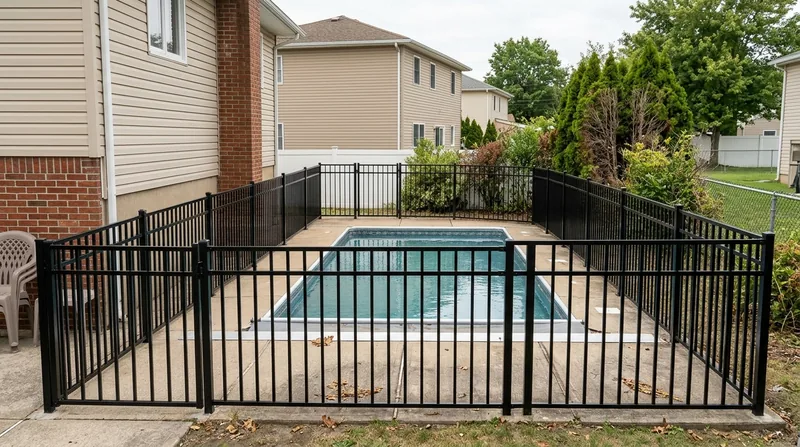




Pool fence installation in New York City is a code-driven project that keeps your backyard safe and your liability exposure contained. Whether you have a raised ranch on Staten Island with a new in-ground pool, a Queens colonial with a vinyl-lined above-ground setup, or a Brooklyn rowhouse with a compact backyard, the pool barrier rules are strict and the stakes are high. New York State law requires a four-sided barrier around any pool, and your local building department enforces it. Winter freeze-thaw cycles heave posts out of alignment, nor'easters push panels over, and salt air off the bays corrodes metal hardware. We install aluminum, mesh, and glass pool barriers built to the code that applies at your address, with self-closing, self-latching gates and posts set deep enough below the frost line so the latch still lines up after the winter thaw.
Why Pool Barrier Code Matters in New York City Backyards
Pool barriers are not optional upgrades or aesthetic choices. New York State law mandates a four-sided enclosure with specific height, gate hardware, and structural requirements, and those rules exist because drowning is the leading cause of unintentional injury death for children ages one to four. Your local building department enforces compliance, and a barrier that does not meet code leaves you exposed to liability and puts you in violation of local ordinance. The freeze-thaw cycle that dominates this region is particularly hard on pool fences: posts set in shallow soil heave upward every winter, gates stop latching, and panels separate from their rails. A properly installed barrier, with posts set below the frost line and hardware rated for the seasonal movement, holds its alignment year after year.
- Posts must be set below the local frost line (typically 48 inches in the New York City area) to resist winter heave.
- Gates must be self-closing and self-latching, with hardware that keeps the latch aligned even after freeze-thaw cycles.
- Barrier height, material, and gap specifications are set by New York State and enforced by your local building department.
- Aluminum and mesh barriers are the most durable options for the coastal salt air and winter weather of the greater New York City region.
A code-compliant pool barrier protects children, satisfies your local authority, and holds up through the brutal seasonal shifts that define this climate.
Key info: Pool barrier rules are set by New York State law and enforced by your local building department. Rules vary by municipality, so verify the specific requirements for your address before installation begins. A homeowner can install their own barrier, but the work must meet code and pass inspection. We walk through the requirements with you and build to the standard that applies at your address.
For detailed New York State pool barrier requirements, consult the New York State Department of Environmental Conservation pool regulations.
How We Install Pool Fences to Code: Step-by-Step Process in New York City
Every pool fence installation begins with a site walk and a conversation about your local code requirements. We locate your property line, identify any obstacles or terrain challenges (sandy soil near Jamaica Bay, rocky ledge in the Bronx and Riverdale, or soft fill that needs special post-setting techniques), and confirm the exact barrier height, gate type, and material that your address requires. Then we call 811 for a utility locate, set posts below the frost line in concrete, and install the barrier and self-closing gate hardware so the latch stays true through the winter freeze and thaw. We do not guess at code, and we do not install a fence that will fail inspection.
- We schedule a free site visit to verify local code requirements and confirm your exact barrier specifications.
- We call 811 for a utility locate and mark the post locations so we miss buried lines and gas pipes.
- We set posts below the frost line in concrete, accounting for local soil conditions (sand and fill near the water table, rocky glacial till in higher elevations).
- We install the barrier material (aluminum, mesh, or glass) to the height and gap specifications your code requires.
- We install a self-closing, self-latching gate with hardware rated for seasonal movement, so the latch lines up after winter.
- We test the gate action and confirm that the barrier meets local code before we finish the job.
The result is a pool barrier that keeps your family safe, passes inspection, and holds its alignment through freeze-thaw cycles and coastal weather.
Local example: A homeowner in Howard Beach, Queens, had an in-ground pool with a mesh barrier installed by a handyman. The posts were set in shallow soil without concrete, and by the second winter, the gate no longer latched. We reset the posts below the frost line, replaced the self-closing hardware, and added anti-sag bracing to the gate frame. The barrier now passes inspection and the gate latches reliably every season.
For related work, see our gate installation and repair service.
| Barrier Type | Description | Best for |
|---|---|---|
| Aluminum Pool Fence | Rigid, powder-coated aluminum panels with self-closing gate hardware. Durable in salt air and resistant to rust and corrosion. | Permanent installations where durability and low maintenance are priorities. Coastal areas and salt-spray zones. |
| Mesh Pool Fence | Removable mesh panels that roll up and store. Self-closing gate. Fast to install and remove seasonally or when not in use. | Above-ground pools, temporary barriers, or homeowners who want to open the backyard when the pool is not in use. |
| Removable Pool Fence | Modular aluminum or vinyl panels that slide into sockets on existing posts. Can be removed and reinstalled without damage. | Renters, temporary setups, or properties where the barrier will be removed seasonally or when the pool closes. |
| Glass Pool Fence | Tempered glass panels with aluminum or stainless steel framing. Maintains sightlines and creates an open, modern appearance. | Premium installations where aesthetics matter and the homeowner wants to maintain views of the pool and backyard. |
Pool Fence Installation Cost in New York City: What to Expect
Pool fence installation in the New York City area starts at around $34 per linear foot for a basic aluminum or mesh barrier with self-closing gate hardware and posts set to code. The total cost depends on several factors: barrier type (aluminum and glass cost more than mesh), your local frost line depth and soil conditions (rocky ledge in Riverdale or sandy fill near Jamaica Bay require different post-setting techniques), gate size and hardware, and whether you need permits or utility locates. A 40-foot perimeter pool barrier typically runs $1,400 to $2,500, but a complex job with difficult terrain, multiple gates, or premium materials can easily exceed that range. We recommend getting 2 to 3 estimates so you can compare approach and price, and always ask whether the quote includes posts set below the frost line and self-closing gate hardware, because those details drive long-term durability.
For a detailed pricing overview and examples of how different materials and site conditions affect cost, see our full pricing guide.
Pool Fence Installation Near Me: What to Look for When Hiring a Fence Contractor in New York City
When you are ready to hire a pool fence contractor, verify that they carry general liability and workers' compensation insurance and can provide a certificate of insurance on request. Confirm that the contractor will call 811 for a utility locate before digging, understands your local pool barrier code and frost line depth, and has experience setting posts to survive freeze-thaw cycles. Get multiple estimates, ask for references from recent pool fence jobs, and verify that any estimate includes posts set below the frost line, self-closing gate hardware, and the specific barrier height and materials your code requires. If you have an HOA or deed restriction, check whether your barrier design needs approval before work begins.
- Confirm that the contractor carries general liability and workers' compensation insurance and can provide proof on request.
- Verify that they will call 811 for a utility locate and mark buried lines before any post holes are dug.
- Ask whether they understand the local pool barrier code requirements and the frost line depth for your area.
- Request references from at least two recent pool fence installations in your neighborhood or municipality.
- Confirm that the estimate includes posts set below the frost line, self-closing gate hardware, and the exact barrier height and material your code requires.
- Check your HOA rules or deed restrictions to see whether the barrier design needs approval before installation begins.
A contractor who takes time to understand your code, gets multiple estimates, and sets posts to survive the winter is worth the conversation.
To schedule a free estimate and discuss your pool barrier requirements, contact us at (917) 994-6008.
Pool Fence Installation in New York City: Pricing Guide
| Service | Price | Details |
|---|---|---|
| Aluminum Pool Fence | Starting at $34/ft | Self-closing gate, posts set below frost line in concrete, includes utility locate and site survey |
| Mesh or Removable Pool Fence | Starting at $28/ft | Temporary or seasonal barrier, modular panels, self-closing gate, ideal for above-ground pools and renters |
| Glass Pool Fence | Starting at $45/ft | Tempered glass panels, aluminum or stainless framing, premium aesthetics, maintains sightlines to pool area |
| Complex terrain or difficult soil | On estimate | Rocky ledge, sandy fill, high water table, or multiple gates require site visit to determine post-setting method |
| Travel and site survey | Included | No separate mileage or call-out fee for New York City, Yonkers, Mount Vernon, and surrounding service areas |
| Free estimate | No obligation | Response within 24 hours at (917) 994-6008, includes site walk and code review before any pricing |
Indicative pricing, the exact cost depends on square footage, finish, and site access. Free personalized estimate within 24h at (917) 994-6008.


